
Sanvir Singh's double ton: Punjab declare at 592/9 vs Andhra as lower order rescues them from 51/4
संवीर सिंह ने रणजी ट्रॉफी में आंध्र के खिलाफ 375 गेंदों में दोहरा शतक जड़ा, जिससे पंजाब ने 156 ओवर में 592/9 पर पारी घोषित की। पंजाब ने 51/4 से उबरते हुए छठे विकेट के लिए 272 और सातवें के लिए 154 रन की साझेदारी की; सलील अरोड़ा ने 144 और एमनजोत चहल ने 150 गेंदों में 9 छक्कों के साथ 122 रन बनाए। उसी दौर में तमिलनाडु ने 571/7 पर पारी घोषित की (प्रदोष रंजन पॉल 208, अजित राम 115*, साई किशोर 36*), जबकि चंडीगढ़ 48/3 पर 522 रन से पीछे है। महत्वपूर्ण संदर्भ: ये सभी आंकड़े प्रथम श्रेणी/रणजी के हैं और इन्हें टेस्ट, टी20 या आईपीएल प्रदर्शन से नहीं मिलाया जाना चाहिए। संवीर का 2018 से करियर में यह दूसरा प्रथम श्रेणी शतक है, सीजन का पहला मैच था और सीमा से उनके रन 47 प्रतिशत से कम आए — यानी यह करियर का अपवाद है, स्थायी प्रवृत्ति नहीं। यह खबर प्रतिभा-आपूर्ति का संकेत है, किसी खिलाड़ी के टी20/आईपीएल मूल्य का प्रमाण नहीं।
Sanvir Singh's double ton: Punjab declare at 592/9 against Andhra after lower order rescues them from 51/4
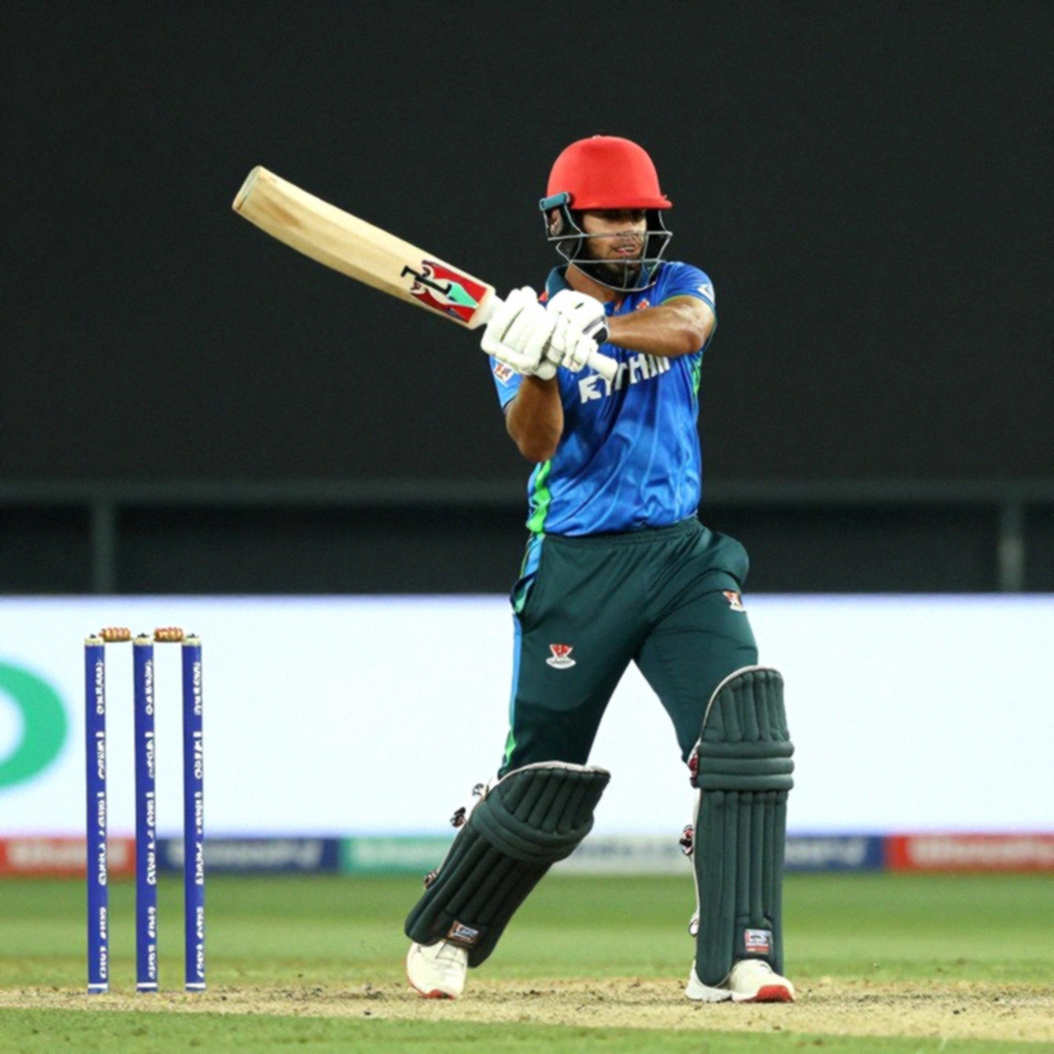
In the current round of the Ranji Trophy Elite Group, Punjab declared their first innings at 592/9 in 156 overs against Andhra. Taken before the close of play on Day 2, the decision looks aggressive at first glance, but in first-class cricket's strategic grammar it is entirely familiar — post a huge total, buy time, and set up the goal of bowling the opposition out twice. The innings' brightest name was the 30-year-old Sanvir Singh, who faced 375 deliveries on the way to a double century, including 22 fours and one six.
But reading the 592 on the scoreboard purely as one batter's achievement does not do justice to this innings. Its real story begins at 51/4. Punjab had lost four top-order wickets for just 51 runs, and at that moment the prospect of pushing the total toward 600 looked remote. Then the batters at numbers six, seven and eight built partnerships that changed the entire complexion of the contest.
The lower order wrote the innings' real chapter
The sixth-wicket stand produced 272 runs and the seventh-wicket stand 154. Salil Arora made 144, Sanvir Singh completed a double century and Emanjot Chahal added 122. This is no ordinary coincidence. When the batters at numbers six, seven and eight all pass a hundred in a first-class innings, the direct implication is that the pitch offered very little assistance to bowlers.
An important conclusion follows. Punjab's top-order collapse was not pitch-induced. Had the surface been offering seam movement or spin, the same pitch could not have yielded 592 runs for the lower middle order. The four wickets Andhra's seamers took with the new ball were a matter of technique and execution, not of the pitch. Once the ball softened and lost its shine, Andhra's attack had no option left capable of breaking a 272-run stand. In other words, Andhra had a new-ball 'breakthrough enforcer' but not the capacity to split a partnership with an older ball.
Sanvir's innings: what the numbers say
The most telling figure in Sanvir Singh's double century is the ball count — 375. Even by first-class standards, facing 375 deliveries is exceptionally slow batting. Of his 200-plus runs, only 94 came in boundaries — under 47 percent of the total. In modern high-scoring domestic cricket, first-class double centuries typically derive 45 to 60 percent of runs from boundaries. Sanvir's figure paints him as an anchor, an accumulator, not an aggressive stroke-player.
That profile is valuable in first-class cricket, where grinding down sessions is part of the strategy. But the same profile is structurally unsuited to T20 cricket, where a player's worth is measured by strike rate. It must be stated clearly here that Sanvir's IPL experience with Sunrisers Hyderabad (2026 and 2026) belongs to a different format universe, and no conclusion about his T20 ability can be drawn from this innings.
Career baseline: the double ton is an outlier, not a trend
Sanvir Singh made his first-class debut in 2026. Before this innings he had exactly one first-class century to his name. One hundred in seven or eight years indicates he has not been an established first-class batter. Even more striking is the fact that this was his first first-class match of the season; his previous first-class appearance had come against Saurashtra last season.
Put those three facts together and the picture becomes clear. A player returning after a long gap, whose career average is unremarkable, suddenly plays a 375-ball innings — this is the classic 'one big score in a career' pattern, not proof of a new capability. Any narrative that 'Sanvir has arrived' would be premature. For any serious assessment, data from the next three to five innings, and ideally performances at different venues, is necessary.

Emanjot Chahal: the most interesting profile in this innings
If any name in this match is the most interesting from a commercial and selection standpoint, it is Emanjot Chahal. He made 122 off 150 balls, including nine sixes. Nine sixes in a first-class innings is unusually high and points to a T20-style game. Coach Amit Uniyal has explicitly called him the 'most exciting allrounder in the state's ranks'. That is not speculation from an unnamed source but the assessment of a named authority, which gives it more weight.
One point about Sanvir Singh must also be recorded — he is described as a 'useful medium-pacer'. The scarce asset in Indian domestic cricket is not 'a batter who scored a Ranji double century' but 'a batter who bowls useful medium pace', because that fills an all-rounder slot. However, this report provides no bowling data for Sanvir, so that value cannot be quantified. This is an absence of information, and no qualitative claim can be built on it.

The parallel match: Tamil Nadu's big total and Chandigarh's struggle
On the same match-day, Tamil Nadu repeated almost the same template — declaring at 571/7. Pradosh Ranjan Paul made 208, Ajith Ram carried the innings forward with 115 not out, and captain Sai Kishore added 36 not out off 35 balls. Two parallel 'bat big then declare' innings at two different venues on the same day suggest that the pitches in this round were batting-friendly; this was not merely one player's individual greatness.
Contrast that with Chandigarh's position — replying to Tamil Nadu's 571/7, they are struggling at 48/3, trailing by 522 runs. This shows that batting-friendly conditions do not automatically help a weaker side. Surviving under scoreboard pressure is a distinct skill, and it is precisely the skill that separates strong and weak domestic teams.
Pitch and conditions: unstated but inferable
The report gives no pitch report, and there is no information on weather, dew or the toss. But a 156-over innings and three centuries at numbers six, seven and eight point to the conclusion that the surface was flat for batting and offered little help to seam or spin bowlers. This is a medium-confidence inference, not an established fact. Its practical meaning is that the picture of Punjab's 'batting depth' built from this innings is conditional. On a seam-assisted or bouncy pitch, the same depth may look thin. Domestic batting depth transfers only partially to international conditions.
Format discipline: do not conflate Ranji and T20
The biggest analytical hazard in this report is that Sanvir Singh's first-class double century and his IPL (T20) experience are mentioned in the same paragraph. That juxtaposition automatically plants a false inference in the reader's mind — that this innings raises his T20 value. It does not. A first-class score, however large, cannot serve as the basis for a T20 evaluation. The data from the two formats must be kept in separate buckets.
It should also be remembered that the report does not state whether Sanvir Singh is retained or released for the 2026 auction. Therefore any claim of a change in his commercial value is not supported by the available information. The general rule is that a Ranji double century may modestly raise 'form' chatter in IPL scouting, but it is not by itself sufficient to change a player's auction tier, because franchise evaluation centres on T20-specific metrics.
Punjab's pace bowling: a structural warning
Another fact emerges from this match. Umesh Yadav transferred to Punjab this season but did not play in this game. The new ball was shared by a 29-year-old debutant, Gursimran, alongside left-arm spinner Harpreet Brar. Handing a debut to a 29-year-old seamer is itself a signal. This is not a celebration of a youth talent pipeline but a patch for available resources. Punjab's pace resources currently appear stretched, and this is not a strength of the team but a depth risk.
The shape of the bowling combination — an unusual seam-spin mix in which the new ball went to a spinner — also indicates that frontline pace availability was limited. Punjab's pace availability will need monitoring through the season, because the ability to take 20 wickets against stronger opponents rests on it.
Conclusion: what this news is really worth
This is routine domestic first-class round coverage, and its analytical essence is a 'talent supply' signal — an indication of which players are producing at first-class level within India's domestic structure. It is not a yardstick for any player's international readiness or T20 commercial value. The innings played here is a career outlier, almost certainly produced on a flat surface, and should be read only in first-class format context.
The most meaningful signal lies in the all-round profiles — multi-skilled players such as Emanjot Chahal, Sanvir Singh and Sai Kishore are rare in Indian domestic cricket and could prove most useful for national team balance. Five things to watch: Sanvir's next three to five innings and his performances at different venues; Emanjot's strike rate and bowling figures; pitch reports for this Ranji round, so that a 'batting-friendly round' can be distinguished from a one-off surface; Punjab's pace availability, especially Umesh Yadav's return; and the consistency of Tamil Nadu's spin all-rounders.
A final, clear caution. Promoting an innings like this as a 'career-defining achievement' is a standard media tendency, but one prior century in seven years and now a 375-ball double century is a deviation, not an improvement. Until data from several consecutive matches and seasons arrives, changing one's view of Sanvir Singh's level would be premature. Likewise, reading this report's headlines as an IPL auction signal would be an evaluation error, because both the strike tempo and the boundary dependence of this innings argue against T20 suitability.